In short: every hypothesis has to be a different angle, not a paraphrase. For that there are two tools: the map of ten angles with its bookkeeping per ad group (tested / pending / result), and the five sources good hypotheses come from — search terms, landing page, history, competitors and customers. An adjective with no data behind it is not a hypothesis.
Rule number one of the cycle is "every hypothesis is an angle, not a paraphrase". Easy to say; hard when it is time to write challenger number twelve for the same ad group. This lesson gives you the two tools: the map of angles (to know what is left to try) and the sources of hypotheses (so the angle comes from data, not from inspiration).
Which angles can you test in an ad?
| Angle | What it promises | Example headline |
|---|---|---|
| Price / saving | Pay less | «Kitchen Taps From €89» |
| Urgency | Solved right now | «Plumber at Your Door in 1 Hour» |
| Trust / social proof | Others did it already | «+12,000 Customers · 4.8/5» |
| Guarantee / zero risk | Nothing to lose | «Free Returns for 30 Days» |
| Specialisation | We are the ones for this | «Implants Only, Since 1998» |
| Variety / choice | You will find yours | «+300 Models in Stock» |
| Speed of service | No waiting | «24 h Delivery Nationwide» |
| Proximity / local | We are right here | «Your Dentist in Chamberí» |
| Novelty | The latest | «New 2026 Collection» |
| Emotional benefit | How you will feel | «Smile Again Without Hiding» |
Plus two "meta-angles" that combine with any of them: the literal keyword (answering the search) and the question («Pull-Out or Fixed Tap?»).
How do you keep track of what's been tested?
The archive sheet (lesson 3) has an "angle" column. From it comes a ten-row table for each ad group:
| Angle | Status | Result |
|---|---|---|
| Price | Tried 2× | Low / Low |
| Urgency | Tried | Best (current champion) |
| Trust | Tried | Good |
| Guarantee | Pending | — |
| Specialisation | Pending | — |
| … | … | … |
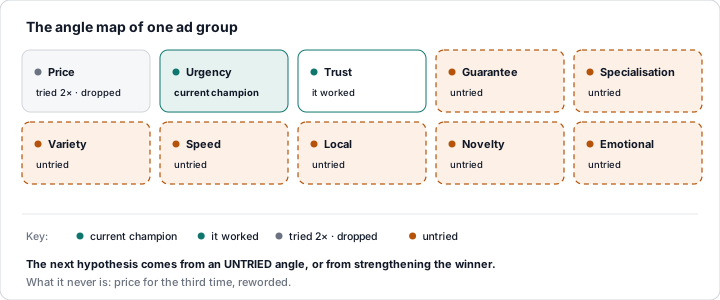
The next hypothesis is obvious: a pending angle, or one that won and deserves a stronger variant. What it never is: price for a third time in different words. And the cross-account read (all groups) uncovers sector patterns: if "price" loses in 18 out of 20 groups, that business does not sell on price, and that is information worth money.
Where do good hypotheses come from?
- Real search terms: the exact words people use to ask for what you sell («urgent», «cheap», «near me», «reviews»). Every recurring word is an angle the audience has already voted for.
- The landing page: what the page promises and the ad does not. A guarantee that is on the website but not in the headline is a free hypothesis.
- The history: the «Best» pieces from other similar groups (lesson 3): an angle that wins in «implants» usually wins in «orthodontics».
- Competitors: the ads in the auction insights report. Not to copy them: to find the angle nobody is using.
- Customer questions: what people ask on the phone before buying is what the headline should be answering.
How do you write a challenger headline?
To replace a «Low» piece in an ad group:
- Angle: one of the pending ones from the group's table.
- Function (Module 4 of the Basic level): is this piece going to be a keyword piece, a benefit piece, a proof piece or a call-to-action piece? Replace like for like, so the set stays complete.
- A concrete fact: a number, a deadline, a figure. With no fact, the angle is just an adjective.
- 30 characters, initial capital, no overlap with the pieces that are staying.
- Log it in the archive with its angle and date before publishing it.
Example: ad group Implants · Price, «Low» piece: «Guaranteed Quality». Pending angle: guarantee. Function: benefit. Fact: 10 years. Challenger: «Implants with a 10-Year Guarantee». Archive: guarantee · benefit · 22/08 · against the champion «Implants From €990».
What is not a hypothesis?
- «Best Implants in Madrid» → an adjective with no fact, no angle at all.
- «Dental Implant Price» when «Dental Implants Price» already exists → a paraphrase: Google treats them as one.
- Changing «From €990» to «From €950» → same angle; that is a price test, not an ad test, and it is measured differently.
💡 Ninja trick: the RSA Optimizer generates its proposals with AI starting from exactly these sources: the group's keywords, the real content of the landing page and the memory of the testing (what was «Best», to follow that line, and what was «Low», so as not to repeat it). And it always produces two proposals with deliberately different angles: if the first is informative, the second attacks on the emotional side. The hypothesis grounded in evidence, written by a machine that has read the group's archive before writing a single line.
What you should remember
- Ten angles; books kept per ad group (tried / pending / result); the next hypothesis is a pending one.
- Hypotheses come from search terms, landing page, history, competitors and customers, not from inspiration.
- Template: pending angle + same function + concrete fact + 30 characters + archive before publishing.
- Adjectives with no facts, and paraphrases, are not hypotheses.