In short: impression share and its two losses add up to ≈ 100 %, and the whole diagnosis is right there: lost to budget with a good CPA means raise the budget; lost to rank means quality, bid, or your target doing its job. As a target it only makes sense for brand: the last impressions are the most expensive and 100 % never pays off.
Every plan starts with one question: how much of the market am I buying, and how much is left? Google answers it with impression share (IS) and its sibling metrics, which almost nobody adds to their columns and which are the only ones that tell you whether a campaign can grow and what is stopping it.
Which impression share metrics are there?
| Metric | What it measures | Formula |
|---|---|---|
| Search impr. share (IS) | Of the auctions you were eligible for, how many you showed in | impressions ÷ eligible impressions |
| Search top IS | How often you appeared above the organic results | top impressions ÷ eligible |
| Search abs. top IS | How often you were the very first | 1st-position impressions ÷ eligible |
| Search lost IS (budget) | Auctions you lost because the daily budget ran out (or was rationed) | — |
| Search lost IS (rank) | Auctions you lost to insufficient Ad Rank (bid × quality below the threshold) | — |
The last three add up to roughly 100%: IS + lost IS (budget) + lost IS (rank) ≈ 100%. "Eligible impressions" is Google's estimate of the
auctions your keywords and targeting qualified for; it is approximate and
moves with the competition.
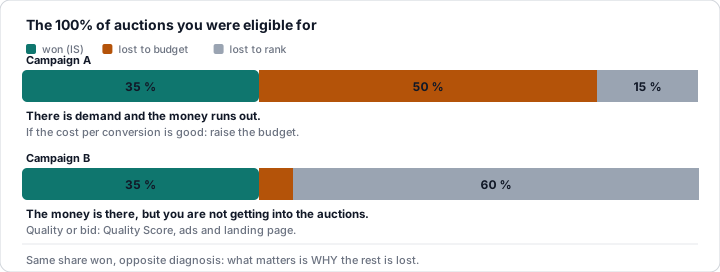
How do you read impression share?
| IS | Lost IS (budget) | Lost IS (rank) | Reading | Action |
|---|---|---|---|---|
| 35% | 50% | 15% | There is demand and the money does not reach it | If the CPA is good: raise the budget |
| 35% | 5% | 60% | The money is there but you are not getting into the auctions | Quality or bid: QS, ads, landing page; then the target |
| 80% | 0% | 20% | Almost the whole market bought | Growing gets expensive (the missing auctions are the worst ones); look for growth in other campaigns/terms |
| 15% | 0% | 85% | Highly contested keywords, or a very low QS | Ask yourself whether that auction is worth fighting for |
And by level: at campaign level it tells you where to put money; at ad group / keyword level it tells you where quality is falling short (lost IS to rank points at the keywords with a low Ad Rank).
Is chasing 100 % impression share a good idea?
Chasing a high IS for its own sake is the classic brand-and-boardroom mistake: "we want to be there all the time". IS is only a reasonable target for brand (target impression share at 90%+ in the top slots). On generics, IS is a diagnosis: 100% includes the auctions that will never convert. The last impressions are always the most expensive.
How does Smart Bidding affect impression share?
With a target CPA/ROAS, lost IS to rank includes the auctions where the algorithm chose not to bid because they did not meet the target: that is not a problem, that is the target working. So the correct reading with Smart Bidding is: lost IS to budget with a good CPA → raise the budget; high lost IS to rank with a good CPA → loosen the target if you want volume (module 2, the judge).
Where do you find impression share?
Columns → Competitive metrics: add all five to your campaign set (module 7 of the Basic level). Segment by device and by time (weeks) to see whether the budget runs out on mobile or only on Mondays. Shopping has its own Shopping IS and lost IS metrics; on Display/video they do not apply in the same way.
How do you see your competitors' impression share?
Auction insights (Basic, module 7) shows your competitors' IS in the auctions you share. Cross-referenced with your own: if your IS drops and a competitor's rises over the same weeks, they are winning auctions off you (bid or quality); if everyone drops, someone new has arrived.
💡 Ninja trick: lost IS (budget) × CPA is the simplest opportunity formula there is: a campaign with 40% lost IS to budget and a CPA 30% better than target has profitable growth available without touching anything else. Guardian and Smart Bidding (SBNS) read exactly that pair every night to propose (or apply, in steps) budget increases where they pay off — and never where the lost IS is down to rank.
What you should remember
- IS + lost IS (budget) + lost IS (rank) ≈ 100%.
- Lost to budget with a good CPA = raise the budget. Lost to rank = quality/bid (or the target doing its job).
- IS as a target only for brand; on generics it is a diagnosis.
- The last impressions are the most expensive: 100% is never worth it.