In short: every search on Google triggers an instant auction. The highest bidder does not win: the best Ad Rank wins, and Ad Rank combines the bid with the quality of the ad and the landing page. That is why one advertiser can pay less per click and still appear above another who bids more. And what you pay is never your bid — only just enough to beat the advertiser below you.
Every time somebody types a search into Google, in the milliseconds it takes the results page to load an auction is held: Google looks at which advertisers want to appear for that search, ranks them and decides how much each one will pay if it gets the click. Understanding that auction is the basis of EVERYTHING else: bids, Quality Score, automated strategies... they are all ways of influencing this mechanism.
Does the highest bidder always win in Google Ads?
The most widespread belief among beginners is: "whoever pays most wins". It is false, and it is the most profitable falsehood you will ever correct. Google does not rank ads by bid, it ranks them by Ad Rank, which combines, among other factors:
- Your bid: the most you are willing to pay for the click.
- The quality of your ad and your landing page: whether your ad genuinely answers what the person is searching for.
- The minimum thresholds Google demands for that auction.
- The context of the search: device, location, time of day, what else is on the page.
- The expected impact of your assets (images, sitelinks, calls...).
How is Ad Rank calculated? An example with numbers
Imagine three advertisers competing for the search «emergency plumber Madrid». Simplifying Ad Rank to bid × quality (the real formula is more complex, but the intuition is exactly this):
| Advertiser | Max. bid | Quality (1-10) | Ad Rank | Position |
|---|---|---|---|---|
| A | €4.00 | 3 | 12 | 3rd |
| B | €2.50 | 8 | 20 | 1st |
| C | €3.00 | 5 | 15 | 2nd |
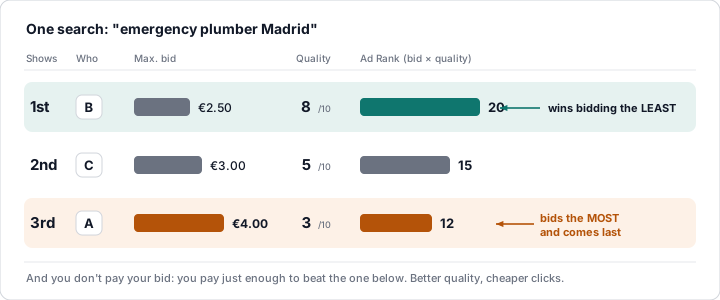
Advertiser B bids less than anyone and comes first, because their ad and their page are the most relevant. This is the outcome Google wants: if bad ads could buy the top position, people would stop clicking on ads, and Google lives off those clicks.
How much do you really pay per click?
Second surprise of the day: you do not pay your bid. You pay the minimum needed to hold your position above the next competitor (plus a cent, as a mental rule). That is why we talk about actual CPC versus maximum CPC:
- If you bid €2.50 but €1.80 was enough to beat the next advertiser, you pay ~€1.80.
- Improving your quality does not just move you up: it makes every click cheaper, because you need a lower bid to hold the same Ad Rank.
💡 Ninja trick: the cheapest lever in Google Ads is not lowering bids, it is raising quality. A more relevant ad pays less to sit higher. That is why we devote a whole module to Quality Score in the Intermediate course — and why our QS Analyzer exists, watching that quality campaign by campaign so you don't have to check it by hand.
How often does the auction take place?
One detail that changes how you think: there is not ONE auction, there are billions a day. Your position for «emergency plumber Madrid» at 3pm on mobile can differ from the one at 9pm on desktop, because each auction is held with its own competitors, its own context and its own thresholds. Two practical consequences follow:
- "Fixed positions" do not exist. Chasing "always being first" is chasing a mirage (and paying dearly for it).
- Averages mislead. All your metrics (average CPC, position, impression share) are aggregates of millions of different auctions. Learning to segment them is learning to see.
What you should remember
- Google ranks by Ad Rank, not by bid: relevance and quality compete against money, and often win.
- You pay the minimum needed for your position, not your maximum bid.
- Better quality = paying less for more. It is the basis of all serious optimisation.
- The auction is per search, not per keyword: context and competition change every time.
In the next lesson we open up Ad Rank and see what that heavily weighted "quality" is actually made of: Quality Score and its three ingredients.