In short: the three ingredients of Quality Score don't weigh the same: expected CTR ≈ landing page > relevance. And relevance is not an end but a means, because Google measures it as CTR. Moreover, the CTR the system uses isn't the one in your column: it combines four histories (keyword-ad pair, account, display URL and geography), so the hygiene of the whole account is inherited.
At Basic level we introduced the three ingredients: expected CTR, ad relevance and landing page experience. What we did not say — and almost nobody says — is that they do not weigh the same, that relevance is a means and not an end, and that the CTR the system uses is not the one in your column. Three ideas that change which battle you pick.
Do the three Quality Score factors weigh the same?
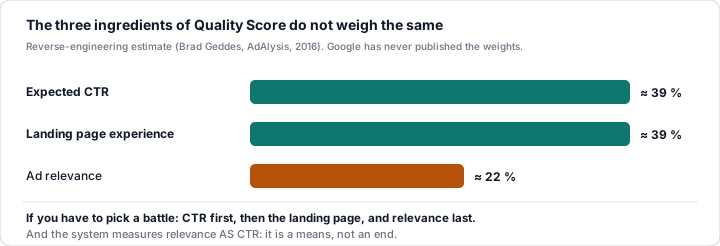
Google never published the weights. In 2016, Brad Geddes (AdAlysis) carried out the most quoted reverse-engineering exercise in the industry, cross-referencing thousands of keywords with their components. His conclusion: starting from a base of 1 point, expected CTR and landing page experience contribute most of the number (up to ~3.75 points each in his model; around 39% each), while ad relevance clearly weighs less (~1.75; around 22%). An example from his model: base 1 + relevance 1.75 + landing 2 + CTR 0 = QS 5/10.
The practical reading: if you have to pick a battle, expected CTR first, then the landing page, then relevance. Relevance is the easiest one to "fix" by rewriting ads, but it is the one that moves the number least: improve it as a means to raise the CTR, not as an end.
How does Google measure ad relevance?
A myth worth demolishing: Google does not semantically analyse your term–ad–landing chain the way a linguist would. Repeating the keyword twenty times in the ad does not create relevance. The chain works the other way round: if that alignment makes more people click, then you are relevant. To the system, relevance is CTR; everything else is a means to get there.
An uncomfortable consequence: a "very relevant" ad that nobody clicks is, to Google, irrelevant. And an ad that does not repeat the keyword but wins the click is relevant. The test is the click.
Which CTR does Quality Score really use?
The CTR the system uses is not the one in your column either. Google combines at least four historical versions of CTR:
- The history of the keyword + ad pairing (not the keyword on its own).
- The history of your entire account: yes, the bad keywords in an old campaign drag down the new ones. Account hygiene is an asset you inherit.
- The history of the display URL.
- The CTR in the geographical location where the ad is shown.
On top of that, this CTR is normalised by position: Google discounts the effect of people clicking more at the top. Field experience says that normalisation never fully compensates — being at the top still helps your QS.
Should you bid high when launching a campaign?
Hence a classic tactic that still makes sense when launching campaigns: going in with slightly more generous bids (or target) for the first few weeks, taking high positions, building up a strong CTR history… and then coming down gradually while keeping the score. The good history stays; the high bid does not need to be maintained. The opposite — going in cheap, low down, with a weak CTR — writes a bad history that takes months to erase.
With Smart Bidding the tactic translates into: a slightly looser initial target (Module 2) and impeccable ads and assets from day one, because the first impressions set the expected CTR.
What should you look at in the account to improve QS?
- The component columns per keyword: where does it say "below average"? If it is expected CTR, it is the ad plus position plus history; if it is the landing page, it is the page (lesson 3); if it is relevance, it is ad group structure — the easiest one.
- CTR by network: search partners dilute your visible CTR but they do not count towards your QS on Google search. Segment before judging a keyword.
- Account history: old campaigns with dreadful CTR and "zombie" keywords with impressions and no clicks are still writing history. Pausing them does not erase the past, but it stops making it worse.
💡 Ninja trick: the QS Analyzer charts the three components of every keyword over time and weights them by cost: it does not tell you "you have a 6", it tells you "40% of your spend is on keywords with a below-average expected CTR, and these ten are the ones that would give back the most money if fixed". The battle picked by impact, not by intuition.
What you should remember
- Weights: expected CTR ≈ landing page > relevance. Pick your battle in that order.
- Relevance is a means: Google measures relevance as CTR.
- The system's CTR combines four histories (pairing, account, display URL, geography), normalised by position — account hygiene is inherited.
- When launching: go in strong to build up history and come down afterwards.